Over four months after the application deadline, on Thursday, September 15, 2016, all sixty-nine senior attorney applicants received emails revealing whether they were promoted. It was significant that DPD sent the notices over the noon hour. Whatever the news, we applicants would have to keep working the rest of the day, mingling with co-workers, reporting to court, seeing clients, negotiating with prosecutors, and generally functioning within the fishbowl that is public defense.
For the thirty-five applicants who received happy news of their promotions and new salaries plus tens of thousands of dollars in retroactive pay (the promotions were retroactive to January 1, 2015) their challenge was to contain their joy. Applicants were individually notified so, aside from themselves, they didn’t necessarily know who the winners and who the losers were. It would be bad form for winners to release balloons and break out the champagne within view of the less fortunate, whoever they might be. Their Cheshire cat grins and new bounce in their walk, however, were dog whistles that enabled the new senior attorneys, if they desired, to identify each other and arrange celebratory happy hours as soon as they could finish mandatory duties and make it to their bars of choice.
The other thirty-four applicants, the losers, had to process disappointment in that same fishbowl. We each received the following email from DPD’s director:
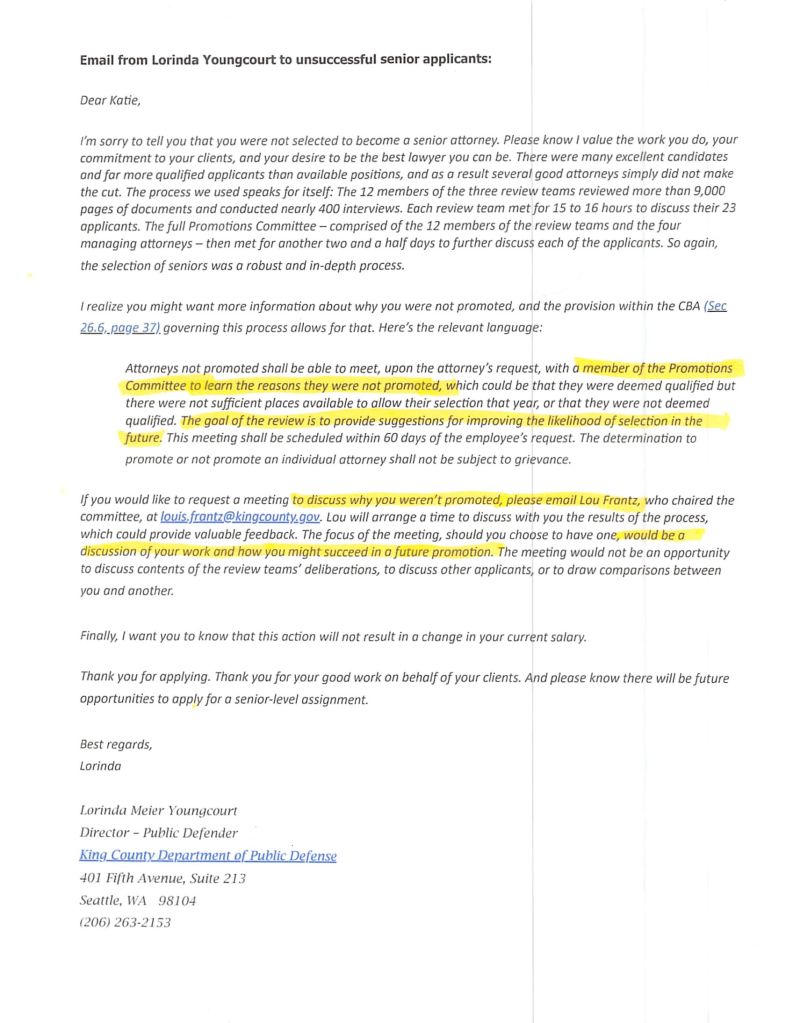
I think my interpretation of Youngcourt’s message was shared by most of my disappointed colleagues. Her words were offensive and, at the same time, defensive.
Rejection letters should be short, like this:
I’m sorry to inform you that you were not selected to become a senior attorney. If you have any questions, contact the chair of the selection committee, Lou Frantz, at Lou.Frantz@kingcounty.gov.
Enough said.
Youngcourt’s additional message that attorneys who were not promoted were “not deemed qualified” or “simply did not make the cut” was not comforting. Her assurance that “this action will not result in a change in your current salary” introduced a concern I never had – that by applying for a promotion I might have risked a reduction in my current salary. Whaaat?! Was I supposed to feel lucky I didn’t lose money by applying for the senior attorney positions?
Youngcourt’s intention was not to console or encourage failed applicants. She sought to convince any applicant who did not “make the cut” that he/she was an inferior attorney compared to the promoted applicants. An impartial committee diligently conducted a fair, “robust and in-depth [selection] process” said Youngcourt. There were so many meetings, such careful review of applications by every committee member, so many hours of discussion, if you weren’t selected, you didn’t deserve to be promoted. Challenges to the selection of seniors would be futile and draw attention to the challengers’ inadequacies. Best for rejects to tuck their tails between their legs and whimper in solitude.
Although Youngcourt offered an opportunity to meet with the chair of the selection committee, Lou Frantz, she conveyed that those of us taking the meeting should not expect much. By quoting the contract, Youngcourt made it clear she was doing the minimum required. At best, we might discuss our work but it would be a one sided conversation. What the committee thought about our work and how our work or any other factor played into the promotion decisions were part of the committee members’ deliberations and, according to Youngcourt, not to be discussed with Frantz.
As for her promise we would be told “how you might succeed in a future promotion,” there never was and never will be another senior attorney promotion opportunity.
Youngcourt’s letter had the opposite effect of her intention to quell challenges to the senior selections. All failed applicants were criminal defense attorneys with keen noses for governmental suppression of evidence (DPD, sadly, is now nothing but a wholly owned subsidiary of King County government). Youngcourt’s clumsy effort to forestall questions alerted me and the others that DPD had something to hide.
A shit storm was brewing but it would be months before Youngcourt’s myth of a completely fair, “robust and in-depth process,” would be busted.
In the meantime, the suffering of rejected applicants would soon be enhanced with an extra dose of humiliation.

 Observations
You must be logged in to post a comment.